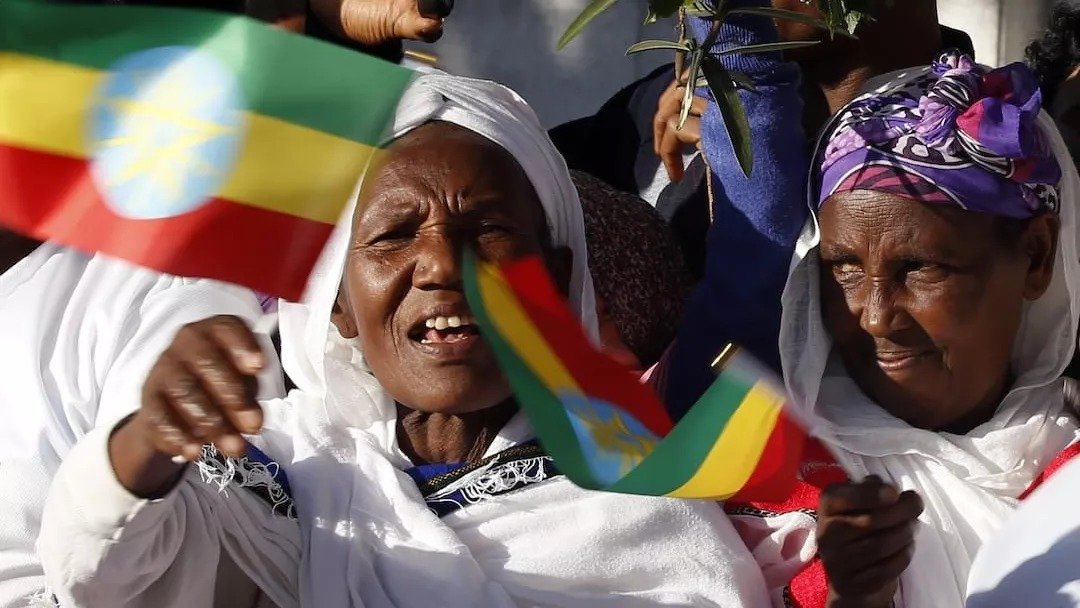
Ethiopia stands at a precarious historical juncture. The confirmation by the National Election Board of Ethiopia {NEBE) that the country's seventh general elections will take place in 2026 has established a definitive timeline for what risks becoming a collision of systemic crises. Unlike previous electoral cycles-often managed exercises reaffirming the dominance of the ruling coalition-the 2026 elections will unfold in the absence of political consensus and within a landscape fractured by unresolved violent conflict.
The central premise of this analysis is that 2026 represents more than a procedural democratic milestone; it is a high-risk inflection point. Ethiopia is currently navigating a "polycrisis"-a condition in which multiple catastrophic pressures occur simultaneously, with their interactions compounding overall harm. The convergence of political fragmentation following the Tigray war, metastasising insurgencies in Amhara and Oromia, a debilitating sovereign debt crisis, and an increasingly assertive foreign policy in the Red Sea has stripped the state of many of its traditional resilience mechanisms.
Absent a credible pre-election elite bargain to reset the rules of political competition, the 2026 vote risks accelerating Ethiopia's slide towards its most dangerous period of instability since the collapse of the Derg regime in 1991. An election intended to legitimise the incumbent Prosperity Party's political vision may instead serve as the detonator for a multi-front conflict that the weakened state apparatus can neither contain nor mediate.
To understand the volatility of the 2026 electoral cycle, one must first examine the structural degradation of the Ethiopian state following the 2020-2022 Tigray war. The conflict, which resulted in hundreds of thousands of deaths, formally concluded with the Cessation of Hostilities Agreement signed in Pretoria in November 2022. However, the post-Pretoria landscape is defined not by genuine peace, but by what scholars describe as a "negative peace": the absence of large-scale hostilities that masks deep, unresolved structural fissures.
The implementation of the Pretoria Agreement has been deeply ambivalent. While the Tigray People's Liberation Front {TPLF) handed over heavy weaponry, the promised restoration of constitutional order and the resolution of "contested areas"-specifically Western and Southern Tigray-remain in a dangerous limbo. These territories, currently occupied by Amhara forces and administratively integrated into the Amhara region, represent a zero-sum struggle between two of the country's most powerful ethno-nationalist blocs. The federal government's inability, or unwillingness, to decisively adjudicate this dispute has left a festering wound that guarantees continued mobilisation on both sides.
The war also fundamentally altered the character of the Ethiopian National Defence Force (ENDF}. Once regarded as one of Africa's most professional militaries, the ENDF has been strained by years of high-intensity internal conflict. Its operational capacity has been degraded, and its cohesion tested by the ethnic polarisation it is tasked with suppressing. Post-war security reorganisation-particularly the federal government's decision to disband regional Special Forces (Liyu Hail} in April 2023-was intended to reassert the monopoly of violence at the centre. Paradoxically, this move backfired, precipitating the mass defection of Amhara special forces into the Fano insurgency and accelerating, rather than reversing, the fragmentation of the security sector.
At the ideological level, the period leading up to 2026 is defined by a clash between Prime Minister Abiy Ahmed's Medemer philosophy-viewed by critics as a centralisation project aimed at eroding regional autonomy-and the entrenched constitutional reality of ethnic federalism. This ideological dissonance has alienated constituencies that once formed the prime minister's support base, leaving the centre increasingly isolated and reliant on coercive force to maintain order. This context underscores why Ethiopia enters the 2026 election cycle already in a weakened and volatile state.
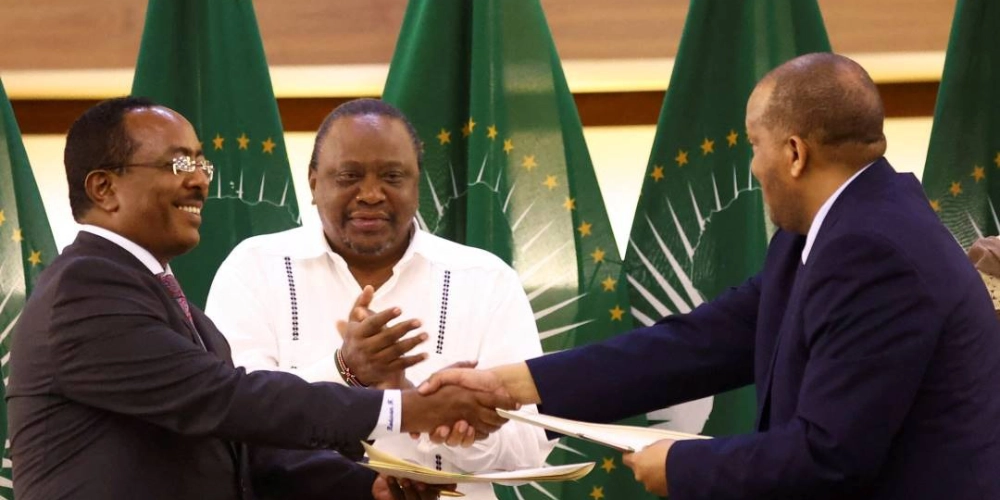
Elections in deeply divided societies require a foundational elite consensus-an agreement among key powerbrokers on the basic rules of political competition-to function as stabilising events. In Ethiopia, no such consensus exists. The institutional mechanism intended to forge this agreement, the National Dialogue Commission (NDC}, suffers from a profound crisis of legitimacy that renders it largely ineffective as a vehicle for conflict resolution ahead of 2026.
The NDC's credibility deficit stems primarily from its perceived lack of independence. Key political actors, including segments of the mainstream Orama opposition-such as the Oromo Federalist Congress-as well as armed insurgencies in Oromia and Amhara, view the commission as an extension of the Prosperity Party's political machinery rather than a neutral arbiter. The process has also been criticised as exclusionary, with stakeholders arguing that a dialogue conducted while key participants remain imprisoned or actively engaged in armed struggle is performative rather than substantive.
The broader political landscape is characterised by what may be described as a "broken triangle" of relationships between the centre and the periphery.
The Amhara divorce: The Amhara elite, previously a tactical ally of the federal government during the Tigray war, now feels profoundly betrayed. The 2023 crackdown on Amhara activists and subsequent military campaigns in the region have severed the historical bond between the Amhara political class and the central state.
The Oromo disenchantment: Despite the Prime Minister's Orama identity, the region remains the epicentre of anti-government insurgency. Many Orama nationalists perceive thecurrent administration as having co-opted Oromo identity while advancing a unitary agenda that undermines meaningful self-determination.
The Tigrayan isolation: While the Tigray People's Liberation Front (TPLF) has entered into a tactical detente with the federal government, Tigray remains economically devastated and politically isolated, biding its time to recover lost influence.
This fragmentation produces a dual impasse. There is no unified opposition coalition capable of challenging the Prosperity Party at the ballot box, nor is there a willingness among armed actors to lay down their weapons for an electoral process they perceive as predetermined. Consequently, the 2026 election risks becoming a contest without competitors, held in a country without a renewed social contract. Rather than resolving conflict, elections conducted in the absence of elite consensus risk intensifying political violence and accelerating state fragmentation.
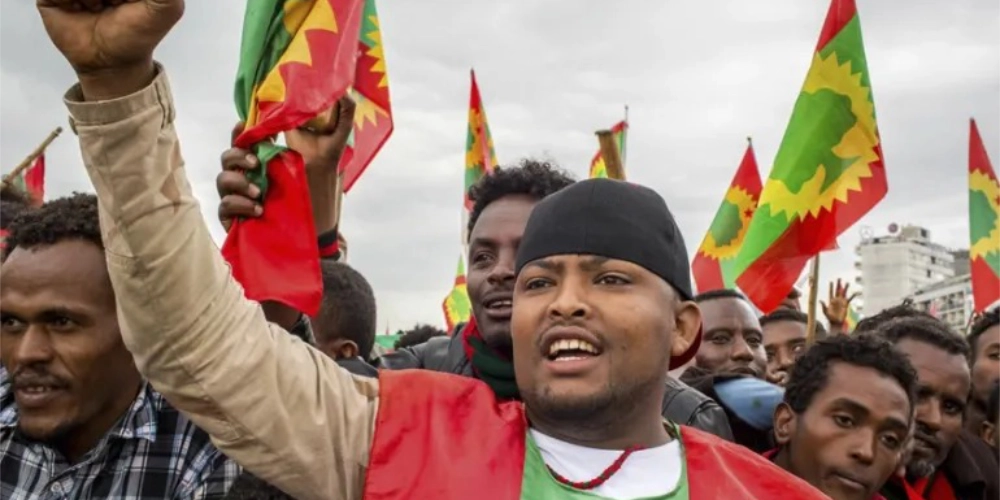
The single greatest threat to the 2026 elections is the erosion of the state's monopoly on violence. Ethiopia's security landscape has devolved into a patchwork of competing armed actors, each controlling territory and commanding significant coercive capacity. This section outlines the internal balance of power and the fragmentation of the country's coercive institutions.
The Fano insurgency (Amhara region):
What began as a loose network of volunteer militias has evolved into a decentralised but highly effective insurgency. Data from ACLED indicates a sharp increase in engagements between Fano militias and state forces since mid-2023. The movement is driven by a narrative of existential threat, fuelled by the perception that the federal government is complicit in the marginalisation and physical targeting of Amhara populations. Unlike the Tigray People's Liberation Front (TPLF), Fano lacks a unified command hierarchy, making it difficult to defeat militarily or engage diplomatically. Operating with deep community support, Fano units control extensive rural areas and contest major urban centres. Their capacity to disrupt electoral logistics-through road blockages, attacks on polling stations, and the intimidation of officials-is significant across large swathes of the country's second-most populous region. This effectively constitutes a parallel military authority and underscores the erosion of the state's monopoly on violence.
The Oromo Liberation Army (OLA):
In Oromia, the Oromo Liberation Army has expanded its operational footprint considerably. Despite multiple rounds of peace talks in Tanzania, negotiations have repeatedly collapsed, resulting in intensified hostilities. The OLA has demonstrated the capacity to strike near the capital, Addis Ababa, and to exercise de facto governance over pockets of territory in western and southern Oromia. The insurgency feeds on widespread youth unemployment and heavy-handed counter-insurgency tactics by the state, creating a self-reinforcing cycle of violence that the Ethiopian National Defence Force (ENDF) has thus far failed to break. This reflects both expanding operational reach and deepening popular discontent.
The crisis of state enforcement:
The ENDF is overstretched, simultaneously deployed to contain the Fano insurgency in the north, the OLA in the centre and south, and to secure borders against external threats. Reports of low morale, logistical bottlenecks, and ethnic mistrust within the ranks have further degraded its combat effectiveness. Compounding these challenges is the role of Eritrea as a force multiplier for instability. Asmara's intelligence and military apparatus remains deeply embedded within Ethiopia's security environment, acting as a spoiler capable of calibrating violence in Tigray or Amhara to weaken the federal government's leverage.
The 2026 elections will therefore take place in a context where no single actor possesses the coercive capacity to enforce either the electoral process or its outcomes. This fragmentation of security authority significantly increases the risk that elections will serve as a trigger for escalatory, multi-front violence rather than a mechanism for political stabilisation.
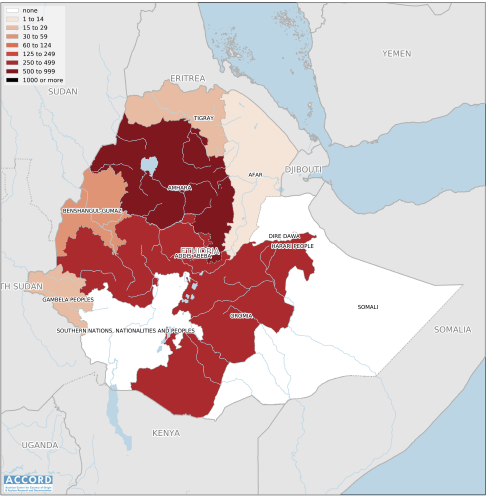
National borders: GADM, 6th May 2018b; administrative divisions: GADM, 6th May 2018a; incident data: ACLED, 1st August 2025; coastlines and inland waters: Smith and Wessel, 1st May 2015
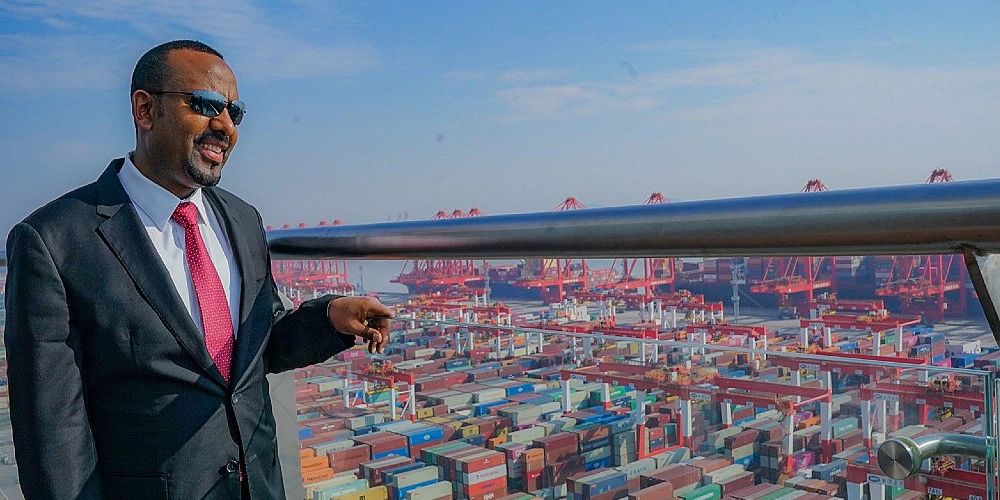
Facing mounting internal pressure, the Ethiopian government has sought to externalise its crisis through an assertive pursuit of sea access-a strategy best exemplified by the January 2024 Memorandum of Understanding (MoU) with Somaliland. This "Red Sea gambit" represents a high-stakes strategic manoeuvre designed to achieve two objectives: securing a sovereign naval and commercial port to reduce dependence on Djibouti, and mobilising domestic nationalist sentiment around a perceived "historic right" to the sea. The MoU thus functions simultaneously as a strategic necessity, a political tool, and a regional provocation.
However, this policy has triggered a regional diplomatic firestorm that threatens to spill into the 2026 election cycle. The Mou-reportedly offering Ethiopian recognition of Somaliland's statehood in exchange for access to a naval base-has been viewed by Mogadishu as a direct violation of Somalia's territorial integrity. In response, Somalia has moved closer to Ethiopia's regional rivals, including Egypt and Eritrea, raising the spectre of proxy confrontation in the Horn of Africa.
The Eritrean dimension:
President Isaias Afwerki views Ethiopia's naval ambitions as a direct challenge to Eritrea's strategic dominance along the Red Sea coast. Relations between Addis Ababa and Asmara-once consolidated by shared hostility towards the Tigray People's Liberation Front (TPLF}--have deteriorated into what increasingly resembles a cold war. Eritrea has responded by deepening ties with Egypt and Somalia and reportedly mobilising troops along the border. The risk is that external actors will exploit Ethiopia's internal fragmentation during the election period to weaken the federal government, potentially by funnelling support to insurgent groups. In this context, Eritrea emerges as an unpredictable and highly consequential spoiler.
The Gulf factor:
The Horn of Africa has also become a theatre for Middle Eastern power projection. The United Arab Emirates, which has invested heavily in Ethiopian infrastructure and supported the Ethiopian National Defence Force (ENDF), backs Abiy Ahmed's port ambitions. Conversely, actors such as Turkey and Qatar-aligned more closely with Somalia-haveviewed the move with scepticism. As a result, the 2026 elections will not be a purely domestic affair but a geopolitical flashpoint in which regional rivalries are likely to play out through local proxies.
Taken together, Ethiopia's Red Sea gambit introduces a new external fault line that intersects dangerously with domestic instability. When combined with internal fragmentation and electoral uncertainty, it significantly increases the risk that regional tensions could ignite into wider conflict during the election period.
Politics in 2026 will be fundamentally constrained by the realities of an economy in deep distress. The "developmental state" model that underpinned the ruling coalition's legitimacy for decades-largely through the delivery of sustained, high growth-has collapsed under the combined weight of debt, war, and global economic shocks.
The sovereign debt crisis:
Ethiopia's external debt position is precarious. Debt service obligations now consume an unsustainable share of export earnings-estimated in recent assessments to exceed 100 per cent-depriving the economy of the foreign currency required to import fuel, medicine, and industrial inputs. The government's default on its Eurobond payment in late 2023 marked both a symbolic and practical turning point, effectively shutting the country out of international capital markets. Negotiations with the International Monetary Fund (IMF) and under the G20 Common Framework for debt restructuring have been protracted and politically costly, requiring the implementation of unpopular reforms, including currency devaluation and the removal of subsidies.
The inflation-instability loop:
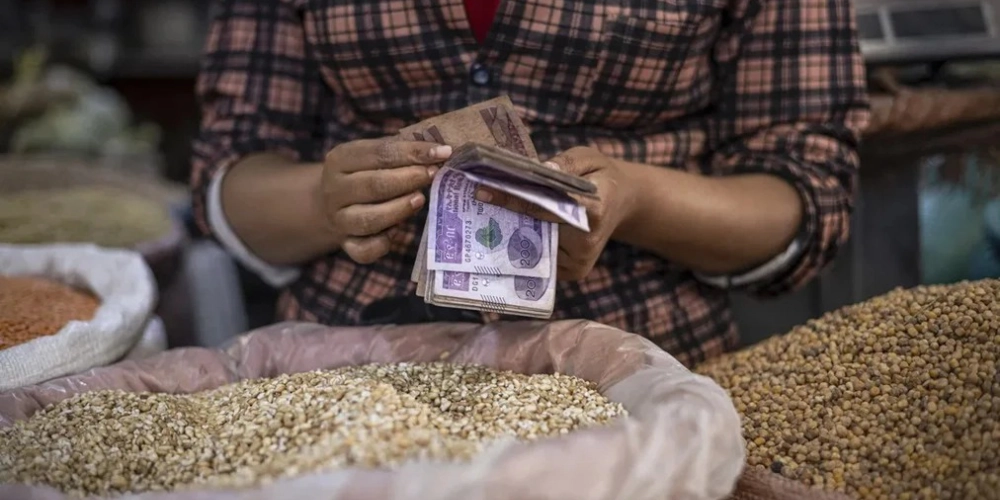
For ordinary citizens, the crisis is most acutely felt through punishing inflation, which has consistently hovered above 30 per cent. The resulting cost-of-living crisis has eroded the Prosperity Party's support base, particularly among the urban poor and the fixed-income middle class. In rural areas, soaring fertiliser prices and market disruptions caused by insecurity have devastated the agrarian economy. Fiscal strain on regional governments has forced austerity measures, weakening social protections and fuelling urban protests.
This economic deterioration has generated a vicious cycle. Lacking the fiscal space to "buy peace" through patronage or development spending, the government has increasingly relied on coercion. Coercive responses, in turn, fuel insurgency and further disrupt economic activity. By 2026, the state may find itself too financially constrained to campaign effectively and too politically unpopular to win a genuinely competitive election, increasing the incentive to manipulate the electoral process. Economic distress thus narrows political options and heightens the risk of conflict-driven, inflationary decision-making.
At the domestic level, the absence of a credible national dialogue has produced a profound legitimacy deficit. Without an elite bargain to reset the rules of political competition, electoral outcomes are likely to be rejected by significant segments of the political class and the wider population before the first ballot is cast. This legitimacy vacuum is compounded by the fragmentation of Ethiopia's security architecture. The state no longer possesses a reliable monopoly over coercion, undermining its ability to secure polling stations, protect candidates and voters, or enforce electoral outcomes in contested regions. In this context, elections risk becoming symbolic exercises detached from enforceable authority.
These internal vulnerabilities are further amplified by Ethiopia's external environment. The government's pursuit of sea access through the Red Sea gambit has internationalised domestic instability, introducing new incentives for regional actors to intervene. Heightened tensions with Somalia, Egypt, and Eritrea create fertile ground for proxy competition, particularly during an election period when the central government's leverage is weakest. Rather than insulating the electoral process, regional geopolitics risk bleeding directly into domestic political contests.
Economic distress provides the final accelerant. Ethiopia's sovereign debt crisis and prolonged inflation have eroded living standards, depleted state resources, and narrowed the government's policy options. Lacking the fiscal capacity to cushion social discontent or co-opt political rivals, the state has increasingly relied on coercive tools to maintain control. This, in turn, feeds grievance-based mobilisation by insurgent groups such as Fano and the Oromo Liberation Army, creating a feedback loop between economic hardship, political exclusion, and violence.
The cumulative effect of these dynamics is that the 2026 elections are likely to function as a trigger event. In an atmosphere of zero-sum competition, disputes over voter registration, campaigning rights, or electoral results could rapidly escalate from localised clashes into nationwide confrontation. Unlike the war in Tigray-which, despite its scale, remained geographically bounded-a post-election crisis could assume an "all-against-all" character, involving inter-ethnic violence in mixed regions, fractures within the security forces, and the erosion of central authority.
The implications extend well beyond Ethiopia's borders. As the demographic and geographic core of the Horn of Africa, Ethiopia's stability constitutes a regional public good. A collapse of the political transition would likely trigger a refugee crisis dwarfing recent displacement flows, placing acute pressure on neighbouring states such as Kenya, Sudan, and South
Sudan-several of which are already grappling with internal conflict. A weakened Ethiopian state would also create a security vacuum in the Red Sea hinterland, a corridor of critical importance to global trade and energy flows, potentially enabling transnational jihadist groups, including AI-Shabaab, to expand their operational reach.
Moreover, the politicisation of port access risks embedding a long-term structural conflict between Ethiopia and its littoral neighbours. Rather than fostering regional integration, competition over access to the Red Sea may entrench the Horn of Africa as a zone of persistent rivalry and militarisation. In this broader context, Ethiopia's 2026 elections are not merely a domestic political event, but a pivotal moment with profound implications for regional stability and international security.
Preventing this outcome requires a fundamental shift in approach by both domestic elites and international partners. The current trajectory towards a "business-as-usual" election must be reassessed. The following recommendations are designed to be realistic and context-sensitive.
Ethiopia is racing against time. The 2026 elections are currently positioned not as a solution to the country's woes, but as an accelerant. The convergence of elite distrust, the proliferation of armed actors, economic bankruptcy, and regional isolation suggests that the conditions for a credible vote do not exist. If the current trajectory holds, 2026 will mark the moment where the Ethiopian state, under the weight of accumulating crises, faces the real risk of systemic failure. The window to alter this course is closing, requiring a move away from performative politics toward genuine, difficult compromise.
Horn Report’s mission is to shape regional narratives and deliver strategic insight that empowers decision-makers to navigate the Horn of Africa’s complexities within an evolving global landscape.