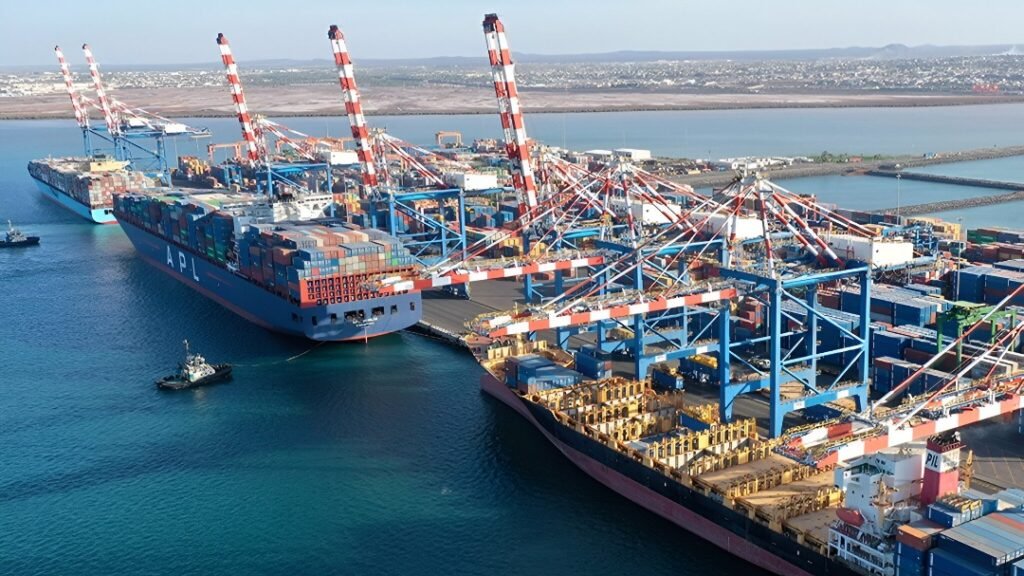
The Horn of Africa, a region straddling the Red Sea and Indian Ocean, occupies a pivotal juncture in global maritime trade, with approximately 15% of global commerce transiting through its waters. Its port cities—from Djibouti’s militarized hubs to Kenya’s debt-laden Lamu corridor—serve as critical nodes in a network that connects Europe, Asia, and Africa, underpinning the economic and strategic ambitions of both regional and great powers. Yet this geostrategic significance has rendered the Horn a theatre of intensifying competition, where foreign military expansion, commercial encroachment, and fragmented governance coalesce to undermine the sovereignty of nascent states.
The proliferation of foreign military bases, exemplified by Djibouti’s transformation into a “garrison state” hosting six foreign installations, and the surge in infrastructure investments under initiatives such as China’s Belt and Road (BRI) and DP World’s port concessions, have redefined the region’s political economy. Dubai-based DP World’s ventures in Bossaso (Puntland) and Berbera (Somaliland), negotiated directly with subnational entities, have not only sidelined Somalia’s federal government but also ignited protracted legal disputes, epitomized by the 2018 arbitration over Djibouti’s Doraleh Container Terminal. These developments, while promising economic modernization, have entrenched dependencies, fueled debt diplomacy, and exacerbated intra-state tensions. The 2024 Ethiopia-Somaliland Memorandum of Understanding (MOU), which trades naval access for diplomatic recognition further illustrates the fragility of sovereignty in an era of contested governance and extraterritorial influence.
Compounding these challenges is the region’s historical struggle with piracy, particularly off Somalia’s coast, which peaked in the late 2000s. While international anti-piracy operations temporarily curbed maritime insecurity, they also catalyzed the militarization of trade routes and justified foreign naval presence—a dynamic now exploited by states and corporations to legitimize permanent military bases and commercial monopolies. The residual threat of piracy, coupled with weak coastal governance, continues to provide pretexts for external actors to deepen their strategic footholds, further eroding local autonomy.
This report examines the interplay of militarisation and sovereignty risks in the Horn’s port cities, arguing that the region’s strategic value has become a double-edged sword. While offering opportunities for economic integration, unchecked foreign engagement threatens to destabilise fragile political architectures, amplify governance fragmentation, and entangle host nations in geopolitical rivalries. Employing a multidisciplinary lens, the analysis navigates the military, economic, and social dimensions of these challenges, evaluates the roles of key stakeholders, and proposes policy pathways to mitigate risks while harnessing the Horn’s geo economic potential.
The Horn of Africa’s port cities, positioned at the confluence of global maritime trade and great- power competition, epitomise the paradox of strategic value: their economic potential is inextricably entwined with mounting sovereignty risks. As a conduit for global commerce transiting the Red Sea and Indian Ocean, the region has become an arena where foreign military entrenchment, infrastructure-driven economic dependencies, and contested governance converge, reshaping its political economy. Nowhere is this more apparent than in Djibouti, which, having transformed into a militarised enclave hosting six foreign bases—including the United States’ Camp Lemonnier and China’s first overseas military installation—derives 20 percent of its state revenue from base leases, a structural dependency that exposes it to shifting geopolitical alignments. The UAE’s abrupt withdrawal from Eritrea’s Assab Port, leaving behind derelict infrastructure and a strategic void, underscores the volatility of such arrangements. Similarly, Ethiopia’s 2024 Memorandum of Understanding with Somaliland, which exchanges naval access for diplomatic recognition, alongside Turkey’s modernisation of Mogadishu’s port, illustrates how militarised diplomacy exacerbates state fragility, eroding federal authority and inflaming regional fault lines.
Maritime security dynamics further reinforce this precarious equilibrium. While international naval coalitions have reduced piracy incidents in the Gulf of Aden from 237 in 2011 to 12 in 2023, their sustained presence has entrenched foreign militarisation under the guise of security. China’s Djibouti base and the EU’s Operation Atalanta, initially conceived as counter-piracy initiatives, now serve as linchpins for broader strategic agendas. Meanwhile, the escalation of Houthi attacks—14 incidents recorded in 2023—has provided additional justification for expanding foreign naval patrols. The region also remains a major conduit for illicit arms trafficking, with smuggled weaponry reaching groups such as Al-Shabaab via coastal routes, reinforcing insurgencies and exploiting governance deficits. The intersection of commercial infrastructure and security imperatives is particularly evident in the UAE’s dual-use investments in Berbera and Turkey’s fortified Mogadishu facilities, where the conflation of economic and military interests systematically erodes local agency.
The governance implications of dependencies are profound. Dubai’s DP World, through direct agreements with Somaliland and Puntland, has circumvented Somalia’s federal authority, igniting protracted legal disputes. These subnational entities, emboldened by external engagements, now negotiate autonomously, further fragmenting governance structures. Concurrently, Eritrea, leveraging its geopolitical isolation, has pivoted towards Russian and Chinese patronage, trading strategic access for regime survival. The cumulative effect is a systematic erosion of centralised authority, as external actors exploit governance vacuums to entrench influence.
Ultimately, the Horn’s ports encapsulate the paradox of strategic entanglement: infrastructure-driven modernisation fosters economic connectivity yet entrenches dependency and external leverage; counterterrorism and anti-piracy initiatives provide a pretext for militarised rivalry; and subnational autonomy accelerates political fragmentation. For both regional governments and international stakeholders, the challenge lies in reconciling economic imperatives with the existential risks of sovereignty dilution—a balancing act that necessitates multilateral oversight, governance transparency, and a recalibration of engagement strategies to harness the region’s geoeconomic potential without perpetuating its
At the heart of this precarious equilibrium, the Horn of Africa’s port cities emerge as epicenters of competing geopolitical agendas, where foreign militarization, debt-driven infrastructure projects, and governance fragmentation coalesce to undermine state sovereignty. This section critically examines the mechanisms through which external actors instrumentalize the region’s strategic significance, fostering economic dependencies, exacerbating legal disputes, and heightening security vulnerabilities. By deconstructing these entanglements, the analysis delineates the structural conditions that perpetuate volatility, challenging the prevailing narratives of development and security cooperation in the region.
Eritrea’s Assab Port, a strategic Red Sea asset, has become a linchpin of foreign militarisation, undermining the nation’s sovereignty through opaque agreements and residual foreign military influence. During the UAE’s involvement in Yemen (2015–2021), Assab served as a critical logistics hub for Emirati and Saudi operations, with the UAE investing over $500 million to upgrade port infrastructure and establish a military base. Despite the UAE’s official withdrawal in 2021, satellite imagery and regional analysts confirm lingering Emirati personnel and equipment, suggesting a de facto military presence that perpetuates Eritrea’s dependency on external actors (ADF Magazine, 2023). This residual footprint highlights how militarisation outlives formal alliances, leaving host nations with militarised infrastructure and diminished control.
Eritrea’s isolation under President Isaias Afwerki’s authoritarian regime has driven it toward new partnerships with Russia and China, both seeking Red Sea dominance. In 2023, Eritrea signed a secretive military cooperation pact with Russia, granting Moscow potential naval access to Assab in exchange for arms and political backing. Similarly, China has intensified engagement, offering infrastructure loans and cybersecurity support while negotiating for a dual-use civilian-military port facility. These moves align with Beijing’s “String of Pearls” strategy and Moscow’s ambition to counter Western influence in the Horn. Eritrea’s desperation to circumvent international sanctions and secure patronage has ceded leverage to these powers, effectively trading sovereignty for survival.
Djibouti’s sovereignty has been significantly eroded through its transformation into a strategic garrison state, accommodating six foreign military installations, including the United States’ Camp Lemonnier and China’s first overseas naval base. These facilities generate approximately 28% of state revenue ($143 million annually), fostering acute economic dependency. However, this reliance has come at the expense of national autonomy. Extraterritorial agreements afford foreign powers near- complete operational freedom—U.S. military personnel remain outside Djiboutian legal jurisdiction, while China’s presence facilitates regional surveillance and force projection. The erosion of territorial control is underscored by incidents such as the 2018 U.S.-China laser dispute, wherein allegations of Chinese interference in American operations remained unaddressed by Djiboutian authorities.
Furthermore, the militarisation of critical infrastructure, notably the Doraleh Port—partially controlled by Chinese state-backed entities—entrenches foreign leverage, reducing Djibouti to a transactional geopolitical space where sovereignty is subordinated to great-power interests.
The intensifying U.S.-China rivalry further exacerbates Djibouti’s sovereign vulnerabilities. With a debt-to-GDP ratio of 87 percent, including $1.4 billion owed to China, Beijing exercises considerable economic leverage, compelling policy concessions such as the 2018 termination of DP World’s port contract under alleged Chinese pressure. Simultaneously, U.S. security assistance ($16 million in 2023) binds Djibouti to Western strategic imperatives. This precarious multi-alignment exposes Djibouti to coercive diplomacy, where its territory risks becoming a theatre for global power
competition. For instance, China’s naval base facilitates intelligence gathering on U.S. operations, while Washington has leveraged sanctions threats over alleged espionage. Such dynamics undermine governance autonomy, compelling Djibouti’s leadership to prioritise foreign military rents over independent policy formulation. Consequently, the state’s capacity to dictate its security and economic trajectory is increasingly constrained, accelerating the erosion of its sovereign agency.
Somalia’s sovereignty has been critically undermined by foreign military engagements that bypass the federal government and empower regional administrations. The UAE’s establishment of a military base and airport in Bosaso (Puntland) in late 2022—marked by at least 12 military flights transporting soldiers and armoured vehicles—exemplifies this erosion. This followed a 2017 agreement with Somaliland to build the Berbera military airport, coupled with Emirati training programs for local forces. By negotiating directly with subnational entities, the UAE has sidelined Mogadishu, fragmenting Somalia’s security architecture and weakening federal authority. These deals grant the UAE strategic footholds along the Gulf of Aden, while Puntland and Somaliland leverage foreign patronage to assert autonomy, deepening institutional fractures. The Ethiopia- Somaliland Memorandum of Understanding (MOU) in January 2024 exacerbates these tensions, as Addis Ababa seeks naval access via Somaliland’s coast in exchange for recognition—a move Mogadishu denounced as an “act of aggression.” Ethiopia’s pursuit of a naval base through a non- state actor not only violates Somalia’s territorial integrity but also incentivizes other regions to seek similar bilateral deals, further destabilising the fragile federation.
Parallelly, Turkey’s consolidation of influence via its largest overseas military base in Mogadishu highlights another dimension of sovereignty compromise. While framed as counterterrorism support, the base entrenches Ankara’s geopolitical sway, with reports of Turkish-trained forces operating independently of federal command structures. This foreign military presence, though sanctioned by Mogadishu, risks creating dependency and distorting domestic priorities, as seen in Somalia’s reliance on Turkish drones and intelligence. Meanwhile, competing Gulf and Horn powers exploit Somalia’s governance voids: the UAE and Turkey back rival factions, while Ethiopia’s naval ambitions fuel interstate tensions. Collectively, these dynamics illustrate how militarisation fragments Somalia’s sovereignty, transforming its territory into a chessboard for external powers and emboldening subnational entities to defy central authority—a cycle that perpetuates instability and undermines prospects for cohesive state-building.
The strategic rivalry between Turkey and Gulf states, particularly the UAE, has turned Somalia into a battleground for geopolitical influence. Turkey has solidified its presence in Somalia through two landmark deals signed in February 2024: a 10-year defence and economic cooperation agreement and a maritime oil and gas exploration pact.
The defence agreement grants Ankara authority to train and equip Somalia’s National Army, deploy Turkish naval forces to safeguard Somali waters, and bolster counterterrorism operations against Al-Shabaab. Central to this is Turkey’s largest overseas military base in Mogadishu, operational since 2017, which serves as a hub for drone operations and intelligence gathering. This facility entrenches Turkey’s role as Mogadishu’s primary security partner, sidelining Gulf-backed regional administrations like Puntland and Somaliland.
The maritime agreement, covering Somalia’s 200,000 km² exclusive economic zone, allows Turkey to explore and exploit offshore oil and gas reserves. This move directly challenges the UAE’s energy ambitions in the Horn, particularly its efforts to secure resource deals with breakaway regions.
Ankara’s dual military-resource strategy aims to counterbalance Emirati influence while securing long-term economic leverage. The UAE has responded by deepening ties with subnational entities. Its 2017 agreement with Somaliland to develop the Berbera Port (a $442 million project) and the 2022 deployment of Emirati troops and armoured vehicles to Bosaso Port in Puntland have empowered regional administrations, undermining Mogadishu’s authority. The UAE’s training of Puntland’s security forces and Somaliland’s coastguard fragments Somalia’s national security architecture, creating parallel chains of command loyal to Abu Dhabi rather than the federal government.
China’s Belt and Road Initiative (BRI) has entrenched its geopolitical and military influence in the Horn of Africa through infrastructure investments that prioritise strategic control over sustainable development. By leveraging debt diplomacy and dual-use port projects, Beijing has deepened dependencies while eroding host nations’ sovereignty. China’s infrastructure projects blur civilian and military objectives. Djibouti’s Doraleh Port, managed by China’s SIPG since 2018, includes deep- water berths capable of docking warships and submarines. China’s military base in Djibouti operates under opaque agreements, restricting host nation oversight. Satellite imagery reveals base expansions, including a pier accommodating aircraft carriers, underscoring China’s long-term
strategic foothold. Djibouti grants China disproportionate influence, exemplified by Djibouti’s 2018
termination of DP World’s Doraleh Terminal contract under alleged Chinese pressure.
Djibouti’s reliance on Chinese loans stifles policy autonomy, forcing concessions like preferential tax breaks for Chinese firms. While BRI projects offer short-term infrastructure gains, they ensnare Horn nations in cycles of debt and dependency, enabling China to extract strategic concessions. Dual-use ports and militarised bases erode territorial sovereignty, transforming host states into pawns in Beijing’s quest for global maritime dominance. For the Horn of Africa, the BRI’s legacy risks becoming synonymous with sovereignty bargained away for bricks and mortar.
The United States’ counterterrorism strategy in the Horn of Africa, centred on its military presence in Djibouti, has entrenched its geopolitical influence while exacerbating sovereignty risks for host nations. Balancing security objectives with great power competition, U.S. operations illustrate how counterterrorism frameworks often mask broader strategic ambitions. Camp Lemonnier, the U.S.’s largest African base, houses 4,000 personnel and serves as the epicenter for AFRICOM operations against Al-Shabaab and ISIS. The base supports drone strikes, intelligence gathering, and Special Forces deployments across Somalia and Yemen, with over 40 airstrikes conducted in Somalia in 2023 alone (AFRICOM, 2024). The U.S. pays Djibouti $63 million annually for Camp Lemonnier, a figure revised upward in 2023 to counterbalance China’s expanding base 10 km away.
The European Union (EU) frames its engagement in the Horn through counter-piracy and migration control, but its actions increasingly prioritise economic and strategic interests. Operation Atalanta, active since 2008, has reduced piracy but legitimised a sustained naval presence in the Gulf of Aden. In 2023, the EU allocated €40 million to bolster port security in Djibouti and Somalia, ostensibly to safeguard trade routes accounting for €200 billion in annual EU- Asia commerce. However, these projects, like the Berbera Corridor (co-funded by the EU and UAE), often integrate with Gulf and Turkish infrastructure, sidelining local governance. For instance, EU-trained Somali coastguards report to Mogadishu but rely on Turkish intelligence, creating conflicting loyalties.
Russia, leveraging the Horn’s anti-Western sentiment, seeks to disrupt U.S. and EU influence while securing Red Sea naval access. Its 2023 military pact with Eritrea grants Moscow potential basing rights at Assab Port, a former UAE hub, in exchange for Wagner Group mercenaries training Eritrean forces.
Russia also exploits governance vacuums in Somalia. It offers financial compensation to regional administrations in exchange for fishing rights off its coast, bypassing Mogadishu. Such deals mirror Soviet-era tactics, fostering dependency on Kremlin patronage while undermining federal authority.
Europe’s securitised aid and Russia’s opportunistic militarisation collectively erode the Horn’s sovereignty. While the EU prioritises trade stability, its partnerships with Gulf and Turkish actors deepen external control over ports. Russia, meanwhile, exploits weak governance to expand its military footprint, transforming the Horn into a proxy arena. Both actors, despite divergent motives, perpetuate a cycle where local agency is sacrificed for geopolitical gain.
The Horn of Africa’s ports encapsulate the duality of opportunity and risk: while serving as conduits for economic integration, they remain sites of geopolitical contestation and sovereignty erosion. Navigating these complexities requires a recalibration of foreign engagements, prioritizing multilateral governance, economic diversification, and security transparency. By adopting a strategic framework that balances economic imperatives with sovereignty preservation, regional stakeholders can mitigate destabilising external influences while leveraging the Horn’s geoeconomic potential for sustainable development.
Horn Report’s mission is to shape regional narratives and deliver strategic insight that empowers decision-makers to navigate the Horn of Africa’s complexities within an evolving global landscape.